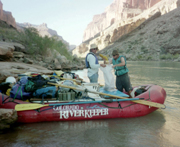
In October, Living Rivers’ Colorado Riverkeeper undertook a 12-day science trip through Grand Canyon National Park. Our assignment was to aid in documenting the status of the river’s food supply for endangered native fish. Ten volunteers witnessed first hand how the river ecosystem is affected due to climate change.
“Because Lake Powell’s reservoir capacity has been reduced by 52%, the chemical and temperature output from the dam is further altering the food web in ways that we have never observed before,” said the Colorado Riverkeeper, John Weisheit. Given this recent turn of events in Grand Canyon, Living Rivers and the Colorado Riverkeeper are now devoting the majority of their resources toward mobilizing national support to save what’s left of the canyon’s native ecosystem. “If the public can’t support protection of this world heritage site, there’s probably little hope for the rest of the river,” concludes Weisheit.
The first obvious observation was a warmer than usual Colorado River. The volunteers knew from experience that the discharge from Glen Canyon Dam normally originates from the chilly depths of the reservoir. While sampling, the volunteers were amazed with the abundant zooplankton found. This indicates that the water used to generate power is coming from the warmer water zone near the reservoir surface, an area containing many exotic life forms, including pathogens and parasites. “It’s only a matter of time before these exotic species from Lake Powell become competitors for the available food that endangered native fish must have to survive. This new condition will become a serious issue for the stakeholders of Grand Canyon,” said volunteer David Haskell, retired science director of Grand Canyon National Park.
Tatiana Lawson, a river guide from Moab, was intrigued with the organisms now existing in the river. “A flatworm is something I expect to see in my biology class at school,” said Lawson, “ not in the Colorado River system. But these newly introduced New Zealand Mud Snails are especially worrisome for me. Tiny as they are, by the millions they are effectively over-grazing the river bottom and depleting the food supply.”
Joe Shannon, a Northern Arizona University aquatic ecologist who has studied the river’s food base for 14 years, supervised the volunteers and staff. “The ecosystem here has changed since I first arrived,” remarked Shannon. “This river was loaded with algae called Cladophora and an invertebrate called Gammarus. Now there is another suite of algal types and Gammarus numbers have declined. The flows from Glen Canyon Dam are not managed consistently and consequently the food web is in constant flux.” Shannon laments how managers continue to be unresponsive to the sound recommendations of his fellow scientists who support flows that mimic the natural flows of the Colorado River. “They continue to manage the dam for hydropower revenues first, with the management mandates of our National Park coming last,” adds Shannon.
“It’s unbelievable how bad things are down here in the Grand Canyon,” remarked Michelle Harrington, coordinator for the Center for Biological Diversity. “The river ecosystem here has completely changed from its unique and natural condition because of Glen Canyon Dam. If the public was fully aware of this condition , I think they would respond in the same way as they have for protecting the Arctic National Wildlife Refuge, and would demand river management alternatives that include the decommissioning of Glen Canyon Dam.”