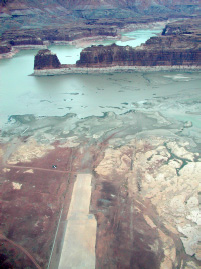
The reservoir-draining drought is again revealing canyon walls not seen in 30 years. For example, the National Parks Service's marina facilities at Antelope Point near Glen Canyon Dam will be perched on a cliff's edge this Autumn.
The situation at Hite Marina at the top of Lake Powell reservoir is already disastrous, where a vanishing reservoir has exposed a sediment plug that backs up the Colorado River Arm for 30 miles. Because of the thick, gooey mud, the Hite concessions operator, ARAMARK, has literally pulled anchor and moved their floating docks 50 miles downstream to the marina at Hall's Crossing. Hite Marina is looking like a ghost town of thick mats of non-native weeds and obnoxious tamarisk trees.
Colorado River runners who previously finished their trips at Hite, now have no place to exit. Thoughts of pushing rafts through a choppy reservoir 50 miles further to Bullfrog or Hall's Crossing marinas are not welcomed. Bullfrog's boat ramp is about to become unusable itself, and Hall's Crossing is too small to accommodate all of the visitors now that these other facilities are closing. In desperation, river outfitting companies are attempting to forge a road across the sediment themselves at a location across the reservoir from Hite.
In a letter to the superintendent at Glen Canyon National Recreational Area, Living Rivers has reminded the National Park Service that the money targeted for capital improvements at Hite Marina must immediately be shifted toward mitigating the impacts from sediment on the river running public, who typically have to endure the National Recreation Area's bias to the powerboat industry. In 2003, power boaters have received $3 million dollars in boat ramp improvements, and river runners have received none.