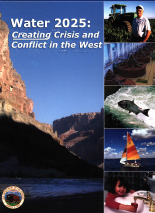
Throughout the summer the Department of Interior, through the Bureau of Reclamation (BuRec), has been orchestrating another of its legendary public relations charades. At a time when most Western states are experiencing major problems with water allocation, BuRec is responding with a long-term managment plan which completely ignores the problem. It is dubbed "Water 2025: Preventing Crises and Conflict in the West," and is little more than a repackaging of existing management strategies combined with a heightened push for desalinization technology. It contains no proposals for how to substantively address major water shortages, such as those already manifesting in the Colorado River watershed.
"Minor efficiency gains and conservation measures as Secretary Norton prescribes will bring about some savings, but these are merely drops in the bucket given that the Colorado River is providing barely half the water the Department of Interior is contracted to deliver," says Owen Lammers, executive director of Living Rivers.
Abundant historical evidence reveals that the present drought in the Colorado watershed is far from unprecedented, and warnings from the United States Geological Survey one year ago urged water managers to be prepared for several decades of below average precipitation. Lammers notes, "Water 2025 demonstrates that the Department of Interior is ignoring this responsibility."
* The Plan emphasizes Interior's long-standing tradition of acquiescing to the states for resolving disputes. However, as 80 years of conflict reveals, cooperation is rare, even in the best of times.
* The Plan's market-driven water banks and transfers from farmers to municipalities during times of shortages are laudable on a small scale, but there is no discussion of what will happen when the real shortages occur. Certainly, the 25 million people reliant on Colorado River water will not be deprived, but what will it cost? Farmers are becoming increasingly reluctant to make water transfers. Without strict federal guidelines and policies, municipalities like Los Angeles, Phoenix, Las Vegas and Salt Lake City will be forced into a cost environment not unlike what California energy utilities faced three years ago.
* Crop substitutions, which represent the greatest opportunities for water savings, are completely ignored by the Plan. Nearly half of Colorado River water is used to grow water-intensive alfalfa and other forms of cattle feed. Much of this water could be saved by growing crops for human consumption.
* The Plan advocates maintaining and enhancing existing infrastructure. However, much of this infrastructure is responsible for the loss of up to 20 percent of the Colorado River's flow due to evaporation and seepage amongst its reservoirs, but there are no capital improvements planned to reduce these losses.
Not until the 25-page report's last 100 words does the term "drought" receive much attention. This should be Interior's main focus at this time. Areas that Interior should be addressing include: outlining specific solutions for federal management to employ; how farmers will be enticed or forced to release their water to preserve municipal economies; and how Interior will enforce necessary conservation strategies and efficiency standards.
"This report is all about carrots with no federal stick," adds Lammers. "Interior must begin developing water use standards and practices, as well as allocation strategies to be implemented as this drought situation worsens. Absent this, crises is inevitable, despite Secretary Norton's report and marketing strategy titled to prevent it."