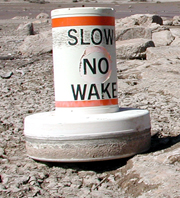
Lake Powell reservoir is down 91 feet from normal; it is officially half empty. The last time it was at this level was 30 years ago when the reservoir was first filling. According to a report that was published in October 1995 by the American Water Resources Association, should a severe and sustained drought similar to past events occur, Lake Powell reservoir is likely to stay empty for approximately eight years.
The National Park Service, which oversees the marina facilities at Lake Powell, has had to make several adjustments to keep the facilities operational since last summer. Despite these adjustments, three boat ramps are presently closed and the ferry service between two other marinas is also shut down.
Additionally, the recently approved $70-million Antelope Point Marina Resort is in jeopardy of being built but never used. To be operational, this facility is totally dependent on having a full reservoir. Right now, at Antelope Point, the reservoir is confined between the sheer vertical cliffs of the original Colorado River canyon and is inaccessible. When considering the demand for water in the lower basin states of California, Arizona and Nevada, compounded by the growing realization that a severe and sustained drought is already upon us, it is possible that the resort may not be useable for decades.
At the top of the reservoir, where the Colorado River enters, major sediment problems are surfacing. The sediment deposits of the last 40 years have built a substantial delta forcing boat ramp and campsite closures, and will eventually engulf the concession facilities and the culinary water intakes.
This situation is also causing extensive complications for white water rafters whose multi-day trips through Canyonlands National Park end at Lake Powell. Their primary facility for getting off the water, Hite Marina, is effectively shut down due to sediment. It’s difficult for land vehicles to get close enough to the water without getting stuck. This could be a major problem for the multi-million-dollar commercial rafting industry that relies on this stretch of the Colorado.
It has been anticipated that the upcoming snowmelt, and the consequent reservoir rise, might bring some relief for the facilities. But a current projection supplied by the Bureau of Reclamation does not support such a hope and indicates lowering will continue through the middle of summer. The snowmelt will actually serve to aggravate the situation because the increased river flows will erode and mobilize the suspended sediments upstream, and then redeposit them at Hite Marina where the Colorado River delta is currently expanding.
Decreased recreation is not the only potential impact of the lowering reservoir. If the present drought does not relent, within three years Lake Powell will eventually drain to the level of the penstock tubes that spin the generators at Glen Canyon Dam.
This problem is not just indicative of Lake Powell. The entire Colorado River storage system has dropped from 92 to 59 percent over the past 40 months. In Arizona, a reservoir on the Verde River is completely empty. A reservoir on the Gila River is four percent full and Lake Roosevelt reservoir on the Salt River is 14 percent full. "Lack of access to flat water recreation is the least of our worries," says Owen Lammers, executive director of Living Rivers. "The Southwest plumbing system is headed for complete catastrophe and the Bureau of Reclamation, together with the seven states that use Colorado River water, have no disaster preparedness plan." For ongoing updates, visit "Drought Watch" at the Living Rivers web page.