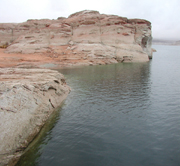
Reservoir levels in the Colorado River watershed are at their lowest point in history. Over the past three years, they have been declining at a rate of ten percent per year and are now at 59 percent of capacity—an approximate three-year supply for the basin’s 25 million residents and farmers. While historical evidence reveals that the present drought is not unprecedented and is likely to continue, the basin’s water managers remain unconcerned.
The most recent sustained drought in the basin took place between 1942 and 1977. The regional climate was marked by less snow and fewer summer rains. No major crisis surfaced because Colorado River consumption was much lower than today. Last year the United States Geological Survey warned that a repeat of this drought could be "catastrophic." It is already shaping up to be much worse than the previous one. River flows during the first several years of the present drought are 15 percent below what they were when the 1942 drought began. Despite hopes that an El Niño event would generate above-average precipitation this year, the most optimistic forecasts now call for snowpacks of 20 percent below normal.
When these issues were raised to Commissioner John Keys of the Bureau of Reclamation (BuRec) last month, he stated that his agency had "no plan" for how the federal government would handle water shortages once reservoirs began running dry. BuRec has merely continuously revised its over-optimistic hydrologic forecasts for river flows. Its most recent, on March 3, was a 25 percent downward revision for flows into Lake Powell. In October 2002, BuRec predicted flows would be 10.14 million acre-feet in the water year of 2003. Now BuRec is predicting only 7.44 million acre-feet—62 percent of normal.
According to Living Rivers’ conservation director John Weisheit, BuRec is also overestimating the amount of available water in its reservoirs. "Their available water figures from Lake Mead and Lake Powell reservoirs do not fully account for the sediment which now occupies storage space. There are another two million acre-feet of storage losses, bringing the overall storage in the basin to 55 percent of capacity."
In a letter sent to Secretary of Interior Gale Norton on March 14, on the occasion of the sixth International Day of Action Against Dams, and for Rivers Water and Life, Living Rivers demanded urgent action by the Colorado River’s legally designated Water Master. As an initial step, Living Rivers is seeking the Secretary’s commitment toward helping to establish a dialogue amongst the basin states, Indian tribes, water users and environmental groups, to begin tackling this critical problem.
The letter outlines two key challenges that need to be addressed. First, bring the basin’s water use into balance with natural flows by re-negotiating the water allocations established in the Colorado River Compact. These allocations are 20 percent above what the river delivers in years of average flow. Second, the federal government should establish water use efficiency standards for all irrigators under contract with the Bureau of Reclamation. These users consume more than 80 percent of Colorado River water, much of it for water-intensive and low-value crops, such as alfalfa and other feed crops for livestock.