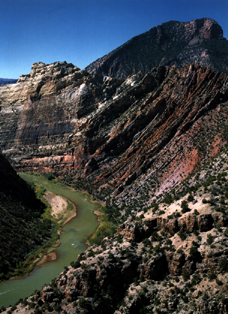
50th Anniversary Yampa & Green River Trip, June 2-6, 2003
In June, 1953 Living Rivers’ co-founder, the late David R. Brower, launched the modern-day river advocacy movement with a trip down the Yampa and Green Rivers in Dinosaur National Monument. His objective, which was achieved, was to raise awareness to defeat the proposed Echo Park Dam and to save the Monument from inundation.
Join Living Rivers and the Colorado Riverkeeper, in association with Holiday River Expeditions and other leading Colorado watershed advocates, as we relive this historic trip and launch a new initiative to save Dinosaur from the much slower death caused by Flaming Gorge Dam upstream. The trip is limited to 25 people, so act quickly. The cost is $1,000.
Participants in this river trip will include activists and naturalists who will openly share their river knowledge with you and your friends. We will discuss the river campaigns of the past and the present, and keep our river ecosystems healthy and our national parks protected. These respected members of the river community include:
Dr. Roderick Nash, who wrote the conservation classic "Wilderness and the American Mind," will row his beautiful wood dory through the towering sandstone cliffs of the Yampa River. The most remarkable cliff face is called Tiger Wall, where tapestries of desert varnish color the surface like the fur of a Bengal tiger.
Jeff Ingram was hired by David Brower when he was the executive director of the Sierra Club, and specifically to help him with the campaign to keep dams out of the Grand Canyon. Mr. Ingram is currently writing a book about this successful campaign and will share this knowledge around the evening campfires after a satisfying dinner.
Dee and Sue Holladay founded Holiday River Expeditions in 1965 and have completed hundreds of river trips in Dinosaur NM. They will share their intimate knowledge of the human and natural history of Dinosaur National Monument as we hike to places of interest.
Kim Crumbo is a famous Colorado River boatman and professional river guide. He is also a passionate advocate of wilderness protection for the river corridors of the Colorado River basin. He is also a respected historian and naturalist, and the author of an excellent river guide that focuses on the human history of the Grand Canyon.
John Weisheit is the trip leader of this expedition and another long-time river guide of the Colorado, and a strong advocate for a free-flowing Green River. He has co-authored a book about the Colorado River in Canyonlands National Park, which will be issued soon by the University of California at Berkeley. The Waterkeeper Alliance recently designated John as the Colorado Riverkeeper for his dedication to protect this endangered watershed.
For more information contact John Weisheit at (435)259-1063.
Holiday River Expedition’s home page
Holiday River Expedition’s Yampa River trip
Maps of Dinosaur National Monument
Living Rivers’ scoping comments on the Flaming Gorge Dam EIS
PDF of Hear the Echo flyer [592 PDF File]
The History of the Echo Park Dam Controversy and the Birth of the River Protection Movement
 The Bureau of Reclamation (the Bureau) became a very bold bureaucracy after the completion of Hoover Dam on the lower Colorado River. With the construction of that high dam, the Bureau was transformed into a government-owned business that provided electricity for the consumer market, which was a deviance from its original mission to provide irrigation water for farmers. This set a precedent for the United States government, because it could now compete with private industries and with its infrastructure subsidized by the US taxpayer.
In later years that boldness took another step, just like an expanding corporation, in the form of a search for new dam sites and with the assistance of western, pork barrel politicians. The Bureau tested the waters, so to speak, by proposing that a dam be built in Glacier National Park, which, as all national parks are, protected by the Organic Act of 1916. That cornerstone Act mandates that park values be forever left "unimpaired by man." That plan rightfully met stiff opposition and the Bureau immediately acquiesced, but did not relent. They decided to try their luck with Dinosaur National Monument, which is protected under the Antiquities Act of 1906.
A certain professor at Harvard University, who had received the Pulitzer Prize for a history novel, steamed under his collar when he heard about the Bureau’s continued aggression on our national treasures. His name was Bernard DeVoto, born and bred in Ogden, Utah, and he wrote a scathing article in 1950 for the Saturday Evening Post and sparked a movement to save river ecosystems that continues to this day.
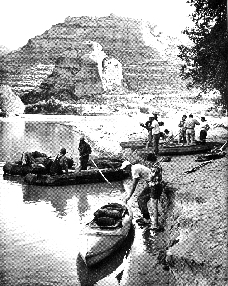
In 1952 the Sierra Club hired its first executive director, David Brower, from Berkeley, California. Brower went to work immediately to further build the grassroots campaign that DeVoto started. He formed a coalition of conservation groups that included the Wilderness Society and the Issac Walton League. He involved another professor and Pulitzer Prize winning author from Stanford University, Wallace Stegner, to edit a book called This is Dinosaur, that would eventually end up in the hands of every member in Congress. Brower also organized week-long river trips to show Sierra Club members and supporters what was to be destroyed should the Bureau’s dam be built. The campaign was successful by using all these organizing components and, by 1956, a vexed Congress killed the authorization to build Echo Park Dam.
Undaunted, the Bureau continued in their relentless campaign to build dams and power plants at the sacrifice of river ecosystems and taxpayers. In 1959 Floyd Dominy, from Wyoming, was appointed as the Bureau’s commissioner and would match the organizing skills of David Brower, but in a contrary, top-down fashion. Audaciously, he envisioned building dams in the Grand Canyon, the most sublime canyon on the planet. Since dams could not be built in lands protected by the National Park Service, Floyd would build them above and below these protected lands. At that time Grand Canyon was a smaller national park, centered at Grand Canyon Village near the south rim.
Brower didn’t waste any time and countered Dominy at every turn to successfully stop these two dams from being built and by using the same grassroots organizing skills as before. But a new twist was added to the campaign, which included a full-page ad in the New York Times and the San Francisco Chronicle. The ad's headline said, "Should we also flood the Sistine Chapel so tourists can get closer to the ceiling?" In 1975, Grand Canyon Park was enlarged and brought under the protection of the Organic Act.
Unfortunately, Brower was not successful in stopping the construction of Glen Canyon Dam. Before he died, in November of 2000, he launched yet another grassroots campaign to decommission this dam before its scheduled 100-year life span is completed; when sediment reaches the intakes of the emergency bypass tubes. On March 14, 2000, on the third "International Day of Action Against Dams, and for Rivers, Water and Life" held at Glen Canyon Dam, Brower, participants and 60 other environmental groups signed the "Glen Canyon Declaration." This document promises to restore the Colorado River in Glen and Grand Canyons to their full natural heritage by means of a grassroots campaign, that includes doing river trips.
Please consider your attendance on our Yampa River expedition, June 2 – 6, 2003, to commemorate a fantastic and exciting future for river restoration.
John Weisheit
Colorado Riverkeeper