Volume 2, Number 5, September 2002
As the last of the fireworks exploded over the Bureau of Reclamation’s (BuRec) $600,000 centennial party at Hoover Dam, a ceremony of a much different sort was underway 250 miles upstream. A river restoration crew labored well into the next morning to deliver three tons of sediment to Grand Canyon’s suffering river ecosystem. With the last grains of sediment deposited, Living River’s first Sediment-al Journey was proclaimed a success.
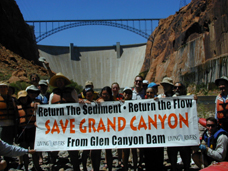
Five nights earlier it all began at a rally on the banks of a free-flowing Colorado above Canyonlands National Park. Accompanied by music, dancing and calls for river restoration, a brigade of activists loaded 300 bags (25-pounds each) of sediment from a sandbar in the middle of the river. The bags were paddled ashore and loaded into a dump truck emblazoned with banners reading “Reclaim the Bureau,” and “Return the Sediment, Return the Flow, Save Grand Canyon from Glen Canyon Dam.”
The caravan then began its journey downstream supported by 85 envi-ironmental and social justice groups demanding immediate action by BuRec to correct the damage Glen Canyon Dam has caused to Grand Canyon’s river ecosystem. More sediment was gathered at the Journey’s second rally at Antelope Point, on the Navajo reservation adjacent to Lake Powell reservoir. Max Goldtooth, a Navajo medicineman and water activist stated, “We’ve not taken care of our rivers and that’s why we’re having these droughts. Our offerings are blocked in their journey to the ocean by these dams.”
The next day road vehicles were abandoned for a flotilla of nine boats to float the 15 miles of the Colorado River below Glen Canyon Dam. Just as the native fish are no longer able to survive in Grand Canyon, we too shivered in the 46 degree water released from the dam. The lack of natural sediment was also fully evident in the crystal clear water. But amidst the 800-foot sheer walls of this, the un-inundated section of Glen Canyon, we made the first offering of sediment back to the river.
Sediment was scheduled to be deposited following the conclusion of a rally held early in the day at Lee’s Ferry, the launch location for Grand Canyon river trips, but the National Park Service banned the release of any of our sediment. “It’s obscure why they want to arrest me for attempting to comply with the Grand Canyon Protection Act, and for attempting to do my part to heal the river,” said Dr. Brent Blackwelder, President of Friends of the Earth.
Following a rally in Grand Canyon National Park the next day, the Journey held its final event at Hoover Dam, a few hours in advance of the BuRec’s centennial celebration. Visitors to the dam were treated to river restoration melodies, dancing fish and the truth about the impacts of BuRec’s devastation of the Colorado. “It’s time for BuRec to get on with the task of decommissioning Glen Canyon Dam,” the Sierra Club’s Marcia Hanscom told the crowd gathered at Hoover Dam. “Grand Canyon deserves better and so does the Colorado River.”
That was the message picked-up by the media at each stop along the 700-mile journey. So although our truckload of sediment, which was finally delivered to the Grand Canyon later that evening represented just .000003% of the amount which it should naturally receive, it represented a significant step toward building public awareness and interest in the reform of the Bureau of Reclamation and restoration on the Colorado River.